Kaizen website case study
- Client
- Kaizen
- Discipline
- Web Design & Development
- Year
- 2026
- Live site
- kaizenhub.co
Results
- Google PageSpeed performance
- 98/100
- Google PageSpeed accessibility
- 100/100
- Google PageSpeed SEO
- 100/100
- Google PageSpeed best practices
- 100/100
Lowe Design, a web design agency in Coleraine, Northern Ireland, designed and built kaizenhub.co, the launch website for Kaizen, a Belfast business portal for agencies, freelancers and consultants. The site was custom coded in Next.js with a Sanity CMS, built to WCAG AAA accessibility, and fully optimised for search engines and AI answer engines. It loads almost instantly and brought in 54 mailing list signups in its first 5 hours live.
At a glance
- Built with: Next.js and Sanity CMS
- Accessibility: WCAG AAA, and 100/100 on Google PageSpeed
- Search: 100% SEO and AEO optimised, and 100/100 for SEO on Google PageSpeed
- Speed: 98/100 for performance on Google PageSpeed
- AI-ready: 3/3 for Agentic Browsing on Google PageSpeed
- Launch result: 54 mailing list signups in 5 hours
The brief
Kaizen is an all-in-one business portal for service businesses. Clients, leads, invoices, proposals, contracts and projects in one place, with Kai, a built-in AI assistant, doing the admin. It has a free plan and a paid Companion plan at £14.99 a month.
Kaizen needed a launch website. Not a holding page. A site that could explain nine connected tools simply, win sign-ups from day one, and get Kaizen named when people ask Google or ChatGPT for business software.
The challenge
A new SaaS product has no reviews, no backlinks and no search history. It is up against big, well-funded names. The site had three jobs.
- Get found in Google and in AI tools like ChatGPT, Perplexity and Google AI Overviews.
- Make it make sense. Nine features, two plans and an AI assistant, explained in seconds.
- Convert. Turn launch-day visitors into mailing list sign-ups.
And it had to work for everyone, on every device, with no lag.
What we built
A custom site in Next.js
No templates. No page builder. We coded kaizenhub.co from scratch in Next.js. That means clean code, a tiny page weight and full control over every detail that affects speed and search.
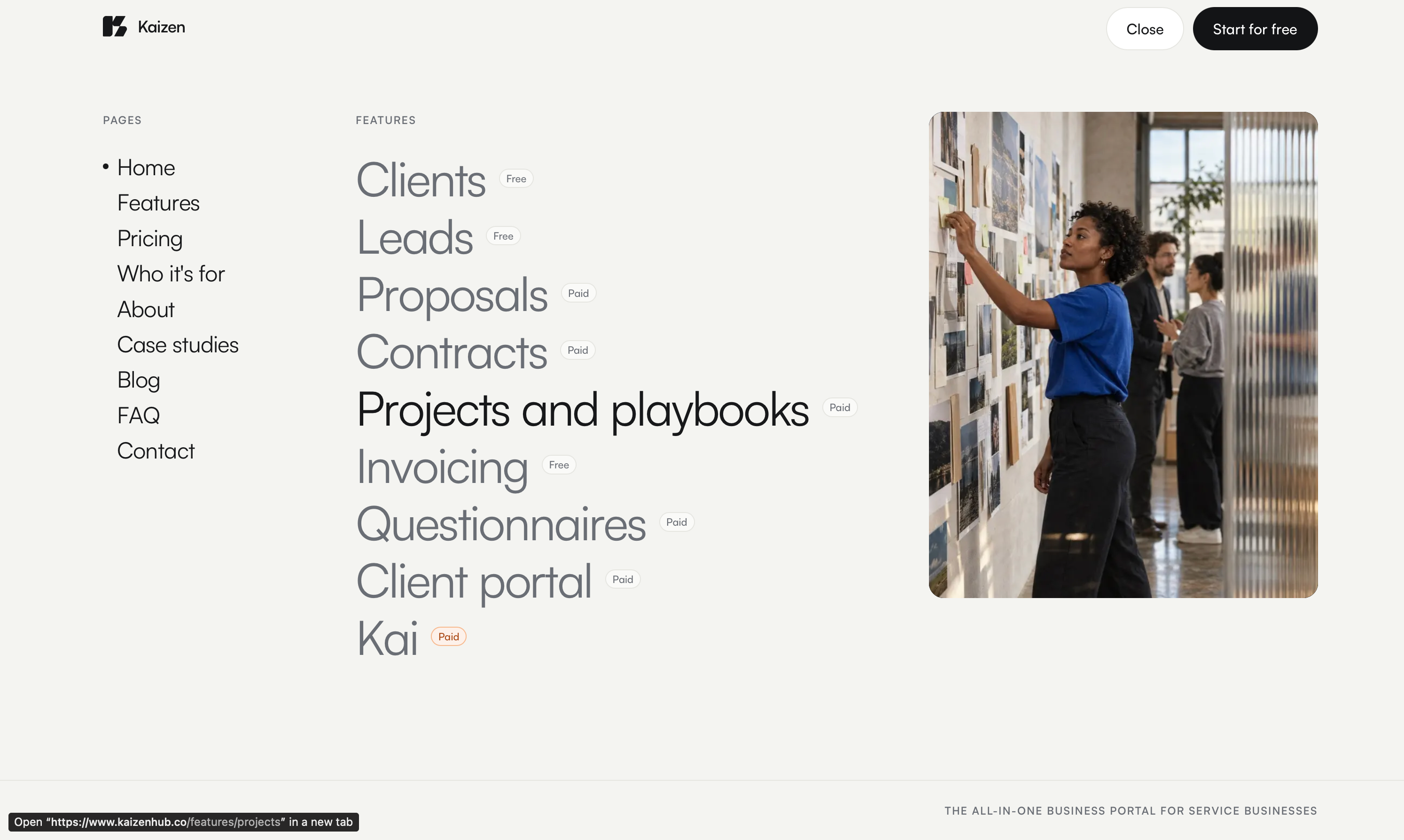
The site covers home, features, pricing, who it's for, about, FAQ, blog, case studies and contact. Each of the nine features has its own page, clearly marked as Free or Paid, so visitors and search engines can see exactly what each plan includes.
Sanity CMS, so Kaizen runs it
The blog, case studies and FAQs sit in Sanity. The Kaizen team can publish and edit content without touching code or waiting on us. New content goes live fast and keeps the site growing in search.
Built for AI search from day one
AEO (answer engine optimisation) was in the plan from the first wireframe, not bolted on at the end.
- Answer-first FAQs. Every answer opens with one clear sentence an AI tool can quote word for word. "Is Kaizen free?" starts with "Yes".
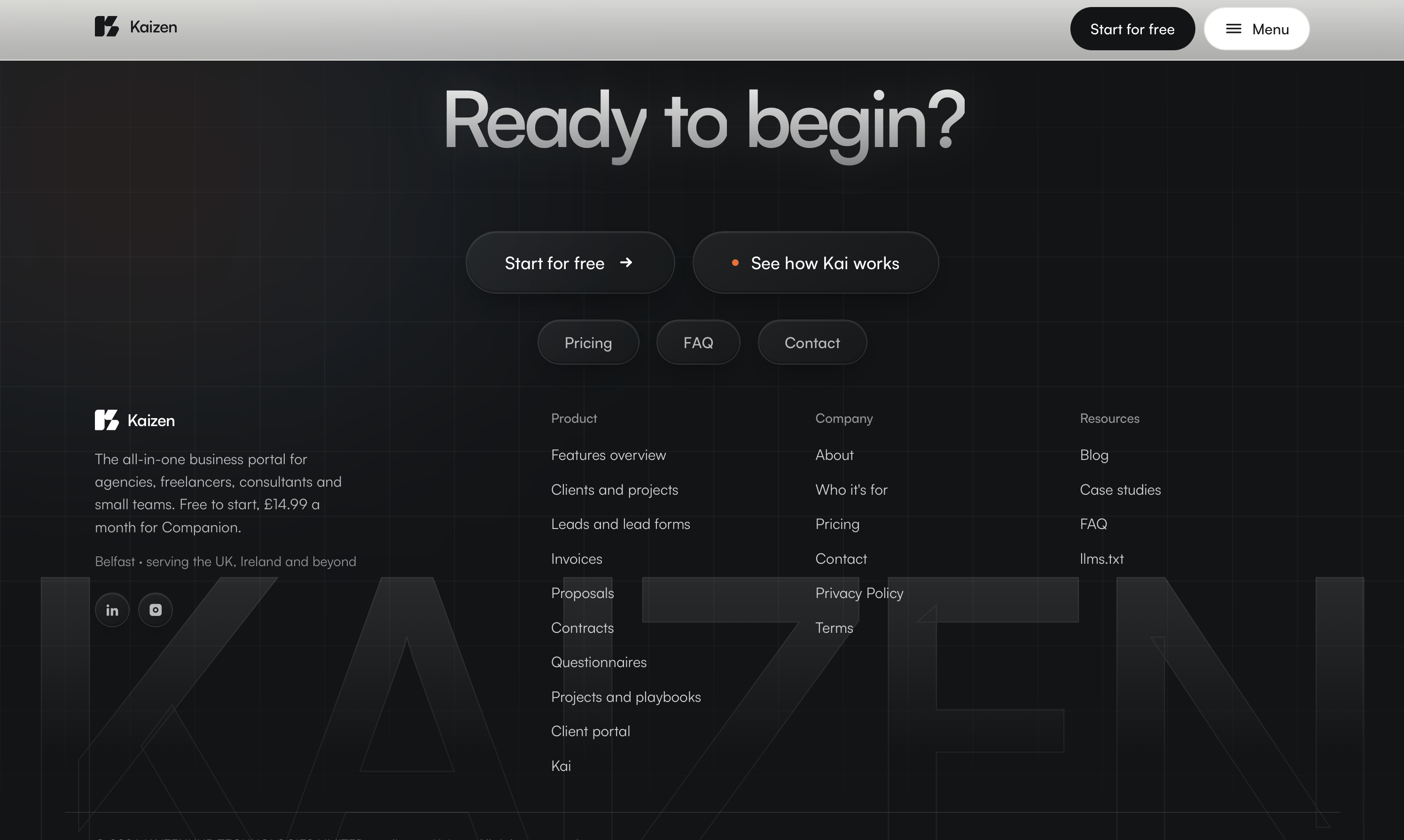
- An llms.txt file. A plain-text guide written for AI tools. It explains what Kaizen is, who it's for, what it costs and where every page lives. It's linked in the footer so it's easy to find.
- Consistent facts. Name, location, prices and plans match on every page, so AI tools never get mixed messages.
- Real sources. Stats on the site link to their source, like the FSB late payment research. AI engines trust content that shows its working.
- Ready for AI agents. The site scored 3 out of 3 for Agentic Browsing on Google PageSpeed. These checks look at how easily AI agents can read and use a site.
SEO done properly
Every page has a unique title, meta description and canonical tag. Social sharing cards are set up for every page. The site is set to UK English. Pages are linked together the way people actually move through them, from feature to pricing to sign-up.
WCAG AAA accessibility
AAA is the highest level of the web accessibility standard. Most sites aim for AA. We went further.
- A "skip to content" link for keyboard and screen reader users
- Descriptive alt text on every image, not just "image1"
- Strong colour contrast and clear, readable text
- Plain, everyday language throughout
Accessible sites are easier for everyone to use. They are also easier for search engines and AI to read.
Near-instant loading
Images are compressed and served in modern formats, at the right size for each screen. The code is lean, with nothing extra slowing the page down. The result is 98 out of 100 for performance on Google PageSpeed.
Copy and design that sell the problem
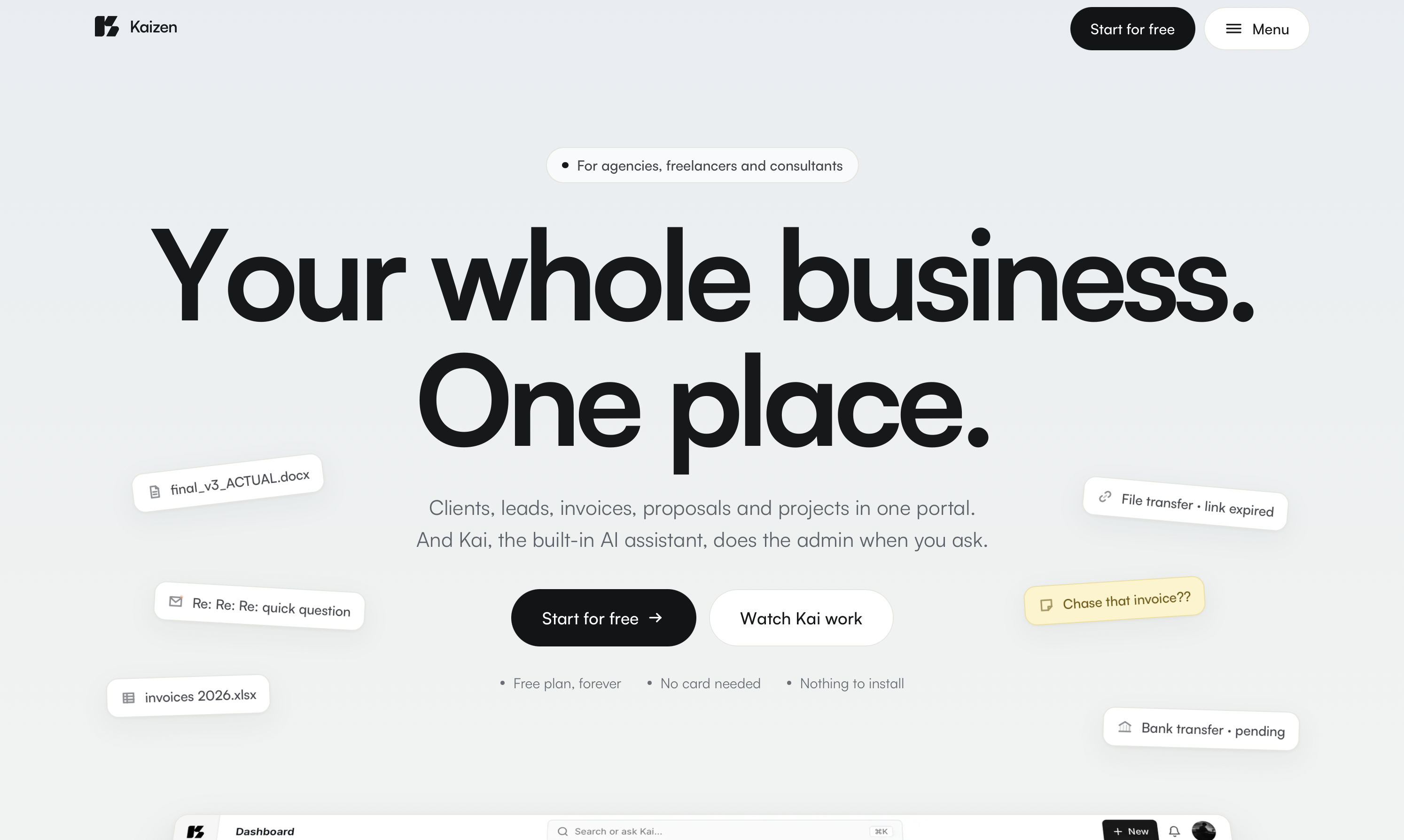
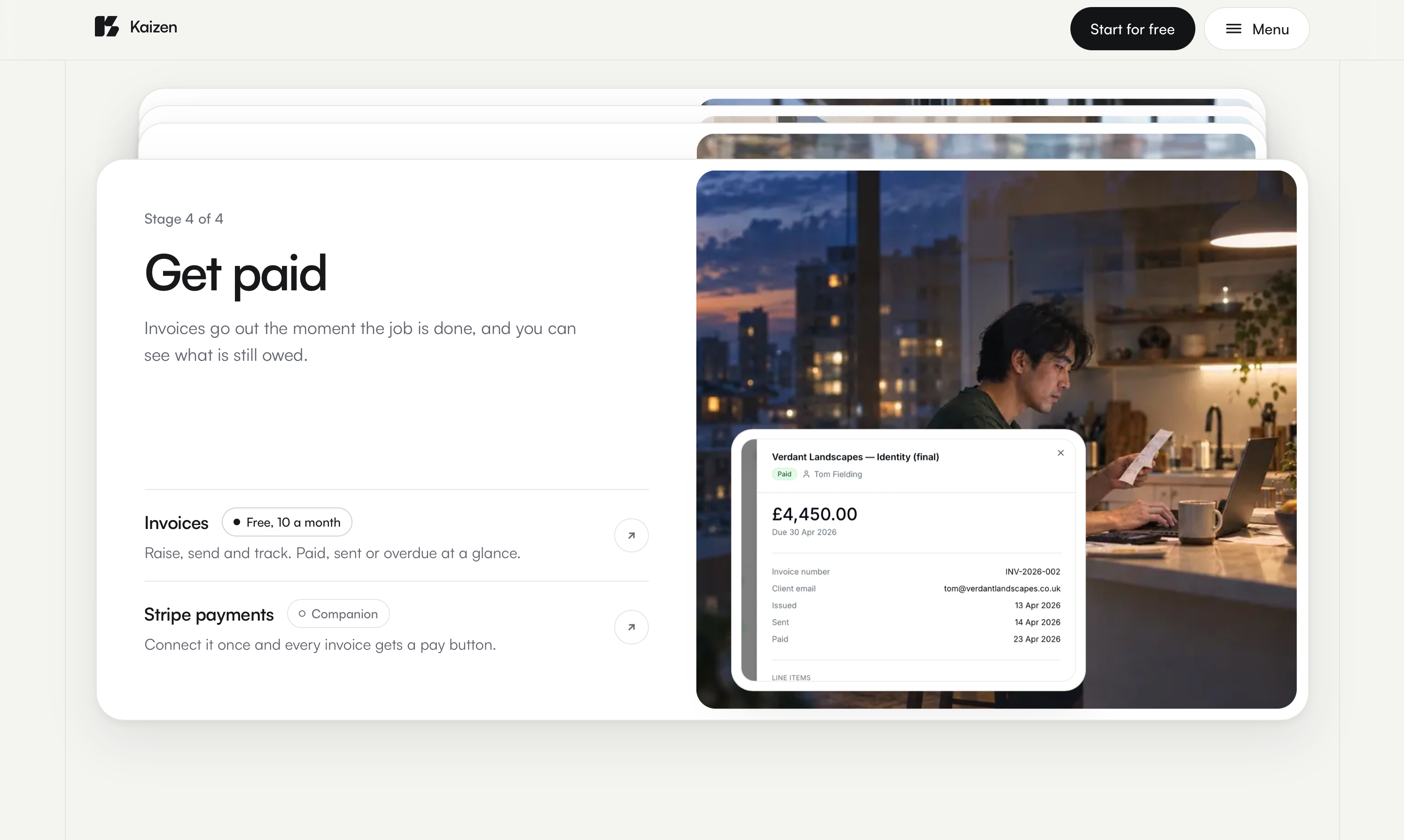
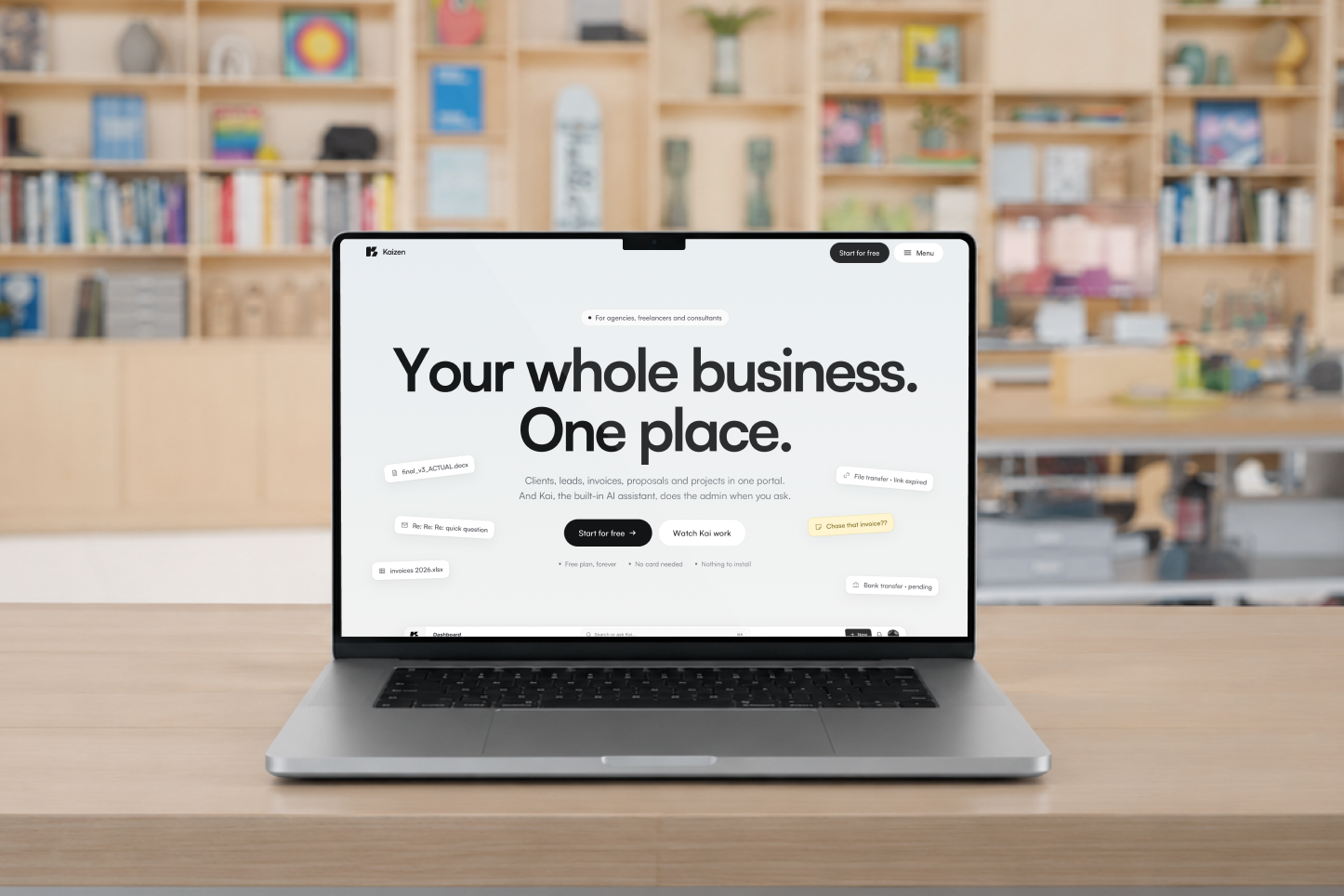
The homepage opens on the mess Kaizen fixes: proposal_FINAL_ACTUAL.docx, the endless "Re: Re: quick question" email chain, the invoice you chase for the third time. Visitors see themselves in seconds. Then the page walks them through Kaizen in four stages: win the work, run the work, keep clients in the loop, get paid.
A live Kai demo shows the AI assistant raising an invoice from one sentence. Pricing is two plans, shown up front. No "contact us for a quote". Every section ends in one clear next step: start for free.
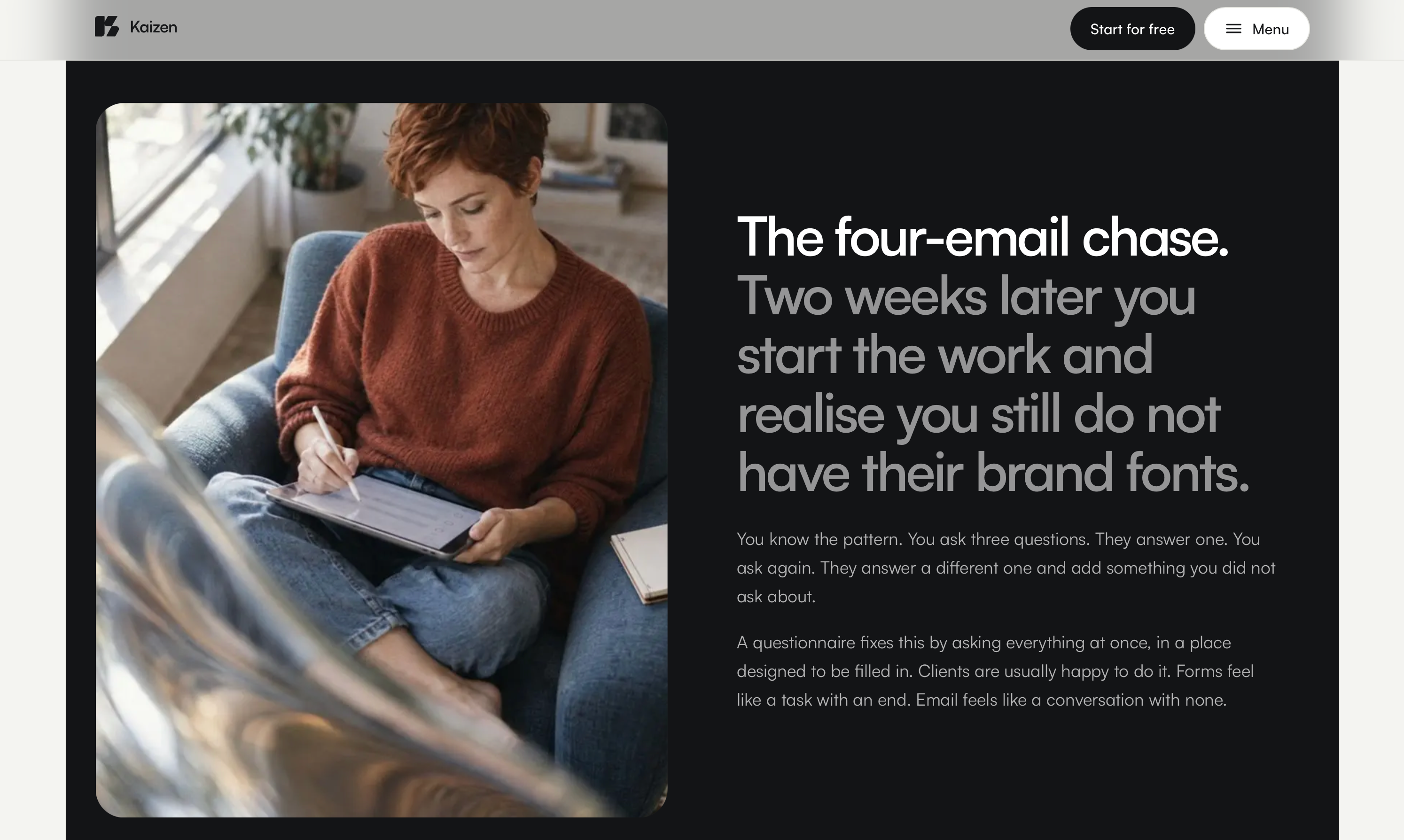
The feature pages tell the same story. Each one opens with a real moment, like the four-email chase for a client's brand fonts, then shows how Kaizen fixes it.
Just as good on a phone
Every section works on a small screen. The "Kaizen replaces" list crosses out each old way of working and ticks off the Kaizen tool that replaces it. The client portal preview lets visitors tap between projects, proposals, contracts, answers and invoices.
The results
In its first 5 hours live, kaizenhub.co brought in 54 new mailing list signups. That is more than 10 an hour, from a brand-new domain with no search history.
Mailing list signups, first 5 hours
54 New signups
Google PageSpeed: Performance
98/100
Google PageSpeed: Accessibility
100/100
Google PageSpeed: Best Practices
100/100
Google PageSpeed: SEO
100/100
Google PageSpeed: Agentic Browsing
3/3
Accessibility standard
WCAG AAA
SEO and AEO optimisation
100%
Content management
Sanity CMS
PageSpeed scores from a desktop test on 23 October 2026, launch day.
A site that is fast, clear and easy to read works harder for every visitor. That is what turned launch-day traffic into sign-ups.
Gallery